
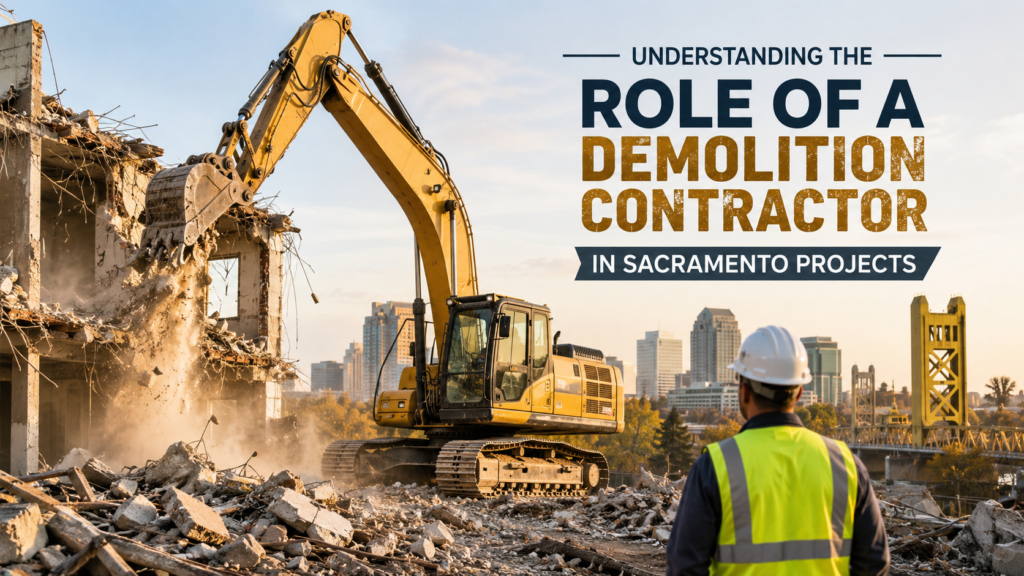
When a property needs to be cleared, renovated, or rebuilt in Sacramento, a Demolition Contractor Sacramento is the professional at the center of that transformation. The Sacramento region spanning the city itself and surrounding counties including Placer, El Dorado, and Yolo supports an active construction and development market where demolition services are in consistent demand. Understanding what these professionals do, how they operate, and what distinguishes a capable contractor from an inexperienced one is useful knowledge for anyone planning a project.
The Scope of Demolition Work in Sacramento
Demolition contracting in Sacramento covers a remarkably wide range of activities. At the large end of the scale, full-structure demolition involves the complete removal of residential, commercial, or industrial buildings. This is typically called for when a structure has deteriorated beyond economical repair, when redevelopment plans require a clean site, or when a building has been condemned as unsafe.
On the smaller scale, demolition work includes interior strip-outs, garage removal, shed and outbuilding teardown, concrete removal, swimming pool demolition, and the selective removal of walls, ceilings, or specific rooms. Many Sacramento homeowners engage demolition contractors specifically for interior work gutting kitchens, bathrooms, or entire floor plans before proceeding with remodels.
Commercial and industrial projects introduce additional complexity. Office buildings, warehouses, retail spaces, and industrial plants require careful pre-planning, specialized equipment, and strong coordination with local authorities. Large commercial demolition in Sacramento often involves multiple trades and a sequenced demolition plan that accounts for structural load redistribution, utility isolation, and public safety measures.
Licensing and Qualifications to Look For
In California, demolition contractors must hold an appropriate contractor license issued by the Contractors State License Board (CSLB). General engineering contractors (Class A) and general building contractors (Class B) are both authorized to perform demolition work as part of broader projects. Specialty demolition that involves only teardown without associated construction may fall under different license classes depending on the scope.
Contractors performing asbestos abatement are required to hold a separate asbestos abatement license, and their crews must meet specific training and certification standards set by Cal/OSHA. Lead abatement work similarly requires specialized certification. Any Sacramento demolition contractor presenting themselves as capable of full-service work should be verifiable through the CSLB database, which is publicly searchable.
Beyond licensure, look for contractors who carry comprehensive general liability insurance and workers compensation coverage. Demolition is classified as a high-risk activity, and proper insurance protects both the contractor’s workforce and the property owner from liability in the event of accidents, damage, or unforeseen complications.
The Pre-Demolition Planning Process
Professional demolition in Sacramento begins long before a single wall comes down. A thorough pre-demolition phase is what separates safe, efficient projects from costly mistakes. This planning phase typically includes a site survey and structural assessment, a hazardous material inspection, utility identification and disconnection coordination, permit applications, and the development of a site-specific demolition plan.
The structural assessment helps contractors understand how the building is constructed, how it will behave during demolition, and how to sequence the takedown safely. Buildings that were constructed during different eras of Sacramento’s growth from early 20th-century craftsman homes to mid-century commercial buildings to modern structures each present different engineering considerations.
Hazardous material inspection is non-negotiable in Sacramento, particularly for buildings constructed before 1980. Asbestos was widely used in insulation, floor tiles, roof shingles, pipe wrapping, and joint compound throughout this period. Lead paint was standard in residential and commercial construction. Mold is commonly found in buildings with moisture problems. All of these must be professionally identified and abated before demolition proceeds, per EPA and Cal/OSHA requirements.
Equipment Used in Sacramento Demolition Projects
The tools and machinery used in demolition depend significantly on the project type and site conditions. Mini excavators are commonly used for residential demolition where space is tight or adjacent structures need to be protected. Full-size excavators with hydraulic breaker or shear attachments handle larger commercial or industrial work. Skid steers equipped with buckets or forks assist with debris loading and site cleanup.
For selective or interior demolition, hand tools sledgehammers, reciprocating saws, pry bars are commonly used alongside dust containment systems. This manual approach allows precision removal while preserving the portions of the structure intended to remain intact.
Truck fleets are an integral part of any demolition operation. Debris must be hauled away continuously throughout the project, and contractors operating their own hauling trucks provide better timeline control than those relying on third-party services. Sacramento demolition contractors serving larger commercial or multi-project clients often maintain fleets capable of sustained hauling across extended projects.
Debris Management and Environmental Responsibility
Sacramento and the surrounding county jurisdictions have increasingly stringent requirements around construction and demolition debris. California’s CalGreen standards encourage diversion of demolition waste from landfills through recycling and repurposing. El Dorado County, for instance, maintains an active Construction and Demolition Debris Recycling Ordinance that requires contractors to document material diversion efforts.
Responsible demolition contractors in Sacramento sort debris on site or at a sorting facility to separate concrete, metal, clean wood, and other recyclable materials from general waste. Concrete can be crushed and reused as base material. Steel and aluminum carry scrap value that partially offsets hauling costs. This approach is both environmentally sound and often economically advantageous for project owners.
Common Questions About Demolition Contractors in Sacramento
What is the difference between demolition and deconstruction? Demolition typically uses machinery to efficiently tear down and remove structures. Deconstruction is a manual, methodical process focused on salvaging as much reusable material as possible. Deconstruction is slower but generates more salvageable material and less landfill waste.
Does the contractor get the permits or does the property owner? In most Sacramento projects, the demolition contractor handles permit acquisition on the property owner’s behalf. The contractor knows which permits apply to the specific scope of work and manages the application process with the county or city.
What makes a residential demolition different from commercial demolition? Scale, complexity, and regulatory requirements differ significantly. Commercial projects typically involve larger structures, more stringent safety protocols, greater coordination with local agencies, and a higher likelihood of encountering complex utility infrastructure and hazardous materials.
Sacramento’s construction market continues to grow, and the demand for skilled demolition contractors remains strong. Whether clearing a single residential lot or managing a multi-phase commercial teardown, the contractors who bring professional preparation, licensed expertise, and responsible debris management to the table are the ones who consistently deliver projects safely and on schedule.